Mary moves in with Jamie
Other PeopleMary Lamb moves in with Jamie after losing both her job and her squat, accepting the invitation he had previously given her to come to his flat. The decision turns a moment of practical desperation into a new shared life, where money offers immediate security but does not erase the poverty and isolation surrounding them.
Circumstances of the Move
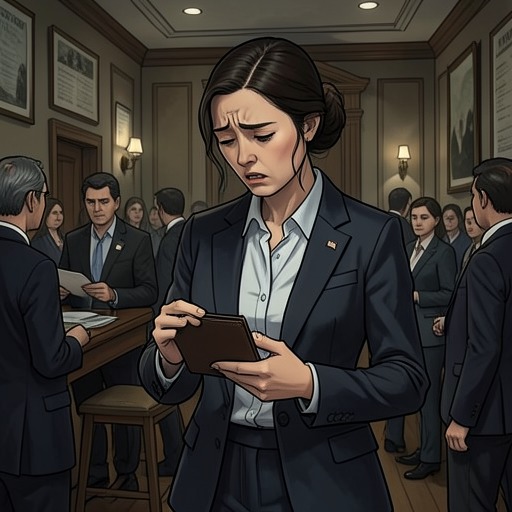
When Prince tells Mary that her job is gone and her squat has also been lost, he presents her situation as nearly exhausted of options. Mary replies that she does have somewhere to go and shows him a piece of paper. Prince recognizes that she has made a connection; Mary explains that she was told she could call and go there at any time. The paper thus matters less as a possession than as evidence of a possible refuge.
Prince puts a telephone in front of her and tells her to make the call. Mary reaches Jamie, who readily agrees that she can come over. His relaxed response contrasts with the abrupt losses Prince has just described. Mary is not surprised: in her view, people have not lied to her, though they have often kept things to themselves. She reserves her suspicion for the person sitting across from her, Prince. Her acceptance of Jamie’s offer is therefore also an act of trust in a connection that has remained available to her.
Money, Poverty, and Choice
The move takes place against a novel-wide contrast between selling time and keeping it. The narrator describes tramps as people without money because they will not sell what others sell: their time. Mary’s own life is not identical to theirs, but money repeatedly marks the terms on which security and choice are available. In an earlier encounter, Sharon considers exchanging two scraps of paper for alcohol, and Mary agrees to the purchase of spirits. Money, paper, and immediate need are linked in a precarious economy of getting through the present.
At the Botham home, Mary learns to shop and takes pleasure in finding bargains. She sees money as useful, even while Mrs Botham resents it. That experience sharpens into a painful awareness of exclusion: Mary comes to understand that life need not be poor in the way she had assumed, and that she wants not the money of the well-kept but their time. Her later move to Jamie does not resolve that deprivation. It gives her a place to go, while leaving the larger question of how she can live with greater freedom unsettled.
Life with Jamie
After Mary arrives at Jamie’s flat, she and Jamie are together there as Christmas approaches. When their companions leave, the flat feels smaller to Mary, not larger, and she is glad to have Jamie to herself. Without thinking much about it, she cuts the telephone cord. The gesture signals a wish to be alone with him and to close off outside contact, though the evidence does not establish that this is part of the original decision to move in.
Jamie’s money becomes a practical resource in their shared life. He tells Mary to take plenty of it and says that they are fortunate to have so much; he also tells her not to worry about what food she buys. Yet his talk of money sits beside his dread of Christmas and his intention to drink during it. Money can ease immediate choices about food, but it does not protect Jamie from distress or make the season welcome to him.
Significance
Mary’s move is a concrete answer to the loss of work and shelter: Jamie’s earlier invitation becomes an available place when other options disappear. The sequence also complicates any simple equation between money and well-being. Mary has learned to recognize both the usefulness of money and the poverty it cannot by itself overcome; at Jamie’s flat, money supports their daily arrangements, while emotional vulnerability remains. The move begins a period of closeness and shared dependence, not a final escape from the conditions that have made Mary’s choices so narrow.